
Buyer’s Guide · Warehouse & Material Handling · Updated 2026
Best Forklift Inspection Software in 2026: Top Platforms Compared
Six platforms for the daily forklift check, compared across thirteen capabilities — how each one guides the operator through the pre-shift inspection, what happens after a defect is found, and where AI actually helps. Every mark is sourced from vendor documentation.
What Is Forklift Inspection Software?
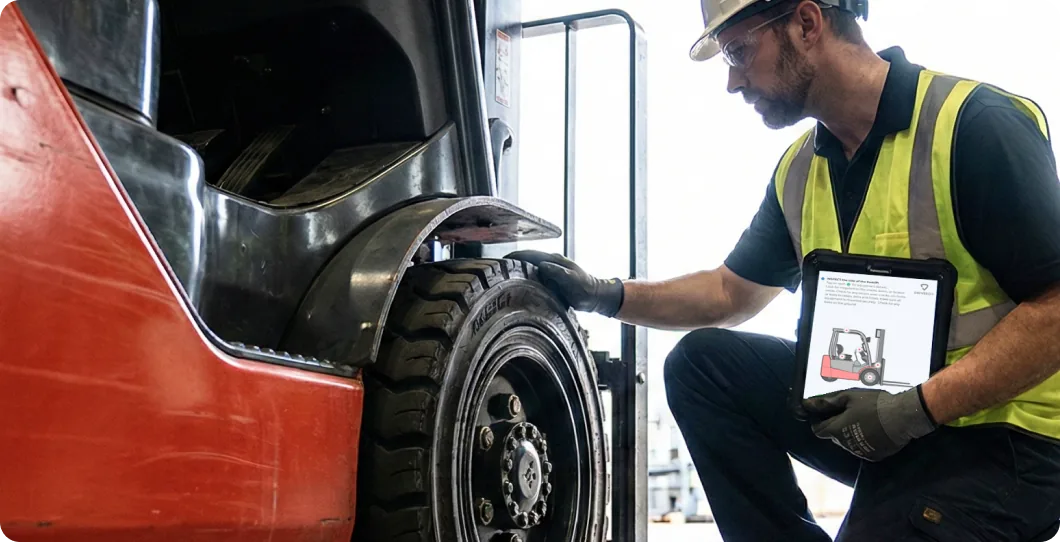
Forklift inspection software guides operators through the pre-shift and post-shift checks that keep a powered industrial truck safe to run. It replaces the paper checklist with a mobile workflow that standardizes what gets checked, captures findings with photos and notes, and in the strongest platforms routes a failed check to the people who can fix it.
The category is also called forklift inspection apps, powered industrial truck inspection software, digital forklift checklists, or forklift safety inspection software. It ranges from a simple pass or fail checklist app to a visual, guided workflow that ties findings directly to preventive maintenance and repair work orders.
Forklift inspection tools trace back to three main origins, and origin still predicts what a platform does well. Some grew out of digital forms replacing paper to digitize the clipboard, but were not built to close the loop after a defect is found. Others grew out of CMMS and fleet management, where an inspection mainly exists to trigger a work order. A third group comes from regulatory compliance and training, extending a DOT and OSHA compliance business into forklift checklists as one more supported equipment category.
Under 29 CFR 1910.178(q)(7), a powered industrial truck must be examined before it is placed in service, and trucks used around the clock must be examined after each shift. OSHA does not require the daily check to be documented, but a digital OSHA forklift inspection checklist gives an employer a clear trail that inspections are happening.
Platforms Covered in This Guide
SafetyCulture
DIY, low-cost checklists built from community templates for occasional or first-time digitizers
MaintainX
Maintenance teams that want mobile access to automate work orders and PM tied to forklift operating hours
MasterCheck
Small operators that want the cheapest dedicated forklift circle-check app
J.J. Keller
Fleets already standardized on Encompass for DOT compliance that also need forklift checklists
Fleetio
Fleets that want forklift checks inside a broader equipment maintenance, parts and repair-network platform
Driveroo
One platform that manages compliance and maintenance together, from guided forklift inspection through defect resolution
Forklift Inspection Software: Comparison at a Glance
Thirteen capabilities that decide whether a digital forklift checklist actually closes the loop — from guided visual inspection points and pencil-whip prevention to what the platform does after a check fails.
Driveroo publishes this guide and appears in the comparison. Every mark is drawn from vendor documentation and third-party material — including the marks that favor competitors — and the reasoning behind each one is recorded in a source and data log.
| Capability | ||||||
|---|---|---|---|---|---|---|
| OSHA Daily Pre/Post-Shift Checklist | ✓ | ✓ | ✓ | ✓ | ✓ | ✓ |
| Visual, Asset-Specific Guided Points | – | – | – | – | – | ✓ |
| Conditional / Branching Logic | ✓ | ◐ | – | – | – | ✓ |
| Photo & Video Defect Capture | ✓ | ✓ | ◐ | ◐ | ✓ | ✓ |
| Pencil-Whip Prevention (prior-issue recall) | – | – | – | – | – | ✓ |
| Issue → Work Order Automation | – | ✓ | – | ◐ | ✓ | ✓ |
| Operating-Hour / Meter-Based PM | – | ✓ | – | ◐ | ✓ | ✓ |
| Parts & Warranty Management | – | ✓ | – | ◐ | ✓ | ◐ |
| Embedded Training / On-Demand Tips | ◐ | – | – | ◐ | – | ✓ |
| AI in Workflow | ◐ | ◐ | – | – | ◐ | ✓ |
| Telematics / Equipment Integration | ◐ | ◐ | – | ✓ | ✓ | ✓ |
| Missed-Inspection Alerts & Dashboard | ◐ | ◐ | ◐ | ✓ | ✓ | ✓ |
| Offline Mobile (iOS / Android) | ✓ | ✓ | ◐ | ◐ | ✓ | ✓ |
| Ratings (G2 / Capterra) | 4.6 / 4.6 | 4.8 / ~4.8 | not confirmed | 4.7 (5) / 4 (1) | ~4.6 / 4.8 | 4.9 / 4.8 |
Compare any platform against Driveroo
Pick a platform to see it side by side with Driveroo, row by row.
Capability
Driveroo
Key: ✓ = full built-in capability | ◐ Partial = limited, add-on, or inconsistently documented capability | – = not available or not confirmed as a primary capability. AI in Workflow note: a Partial mark does not mean the same thing across vendors. SafetyCulture's AI generates checklist templates before an inspection starts. MaintainX's CoPilot AI is an assistant for generating maintenance procedures and surfacing analytics, closer to a lookup or copilot tool than in-context guidance. Fleetio's AI Service Advisor and Smart Uploads operate on repair approvals and service documents in the back office. None of these guide the operator in real time during the inspection itself, which is the distinction the full mark is reserved for. Driveroo ratings are verified from live G2 and Capterra pages.
How to Choose the Right Forklift Inspection Software for Your Operation
1
Every forklift inspection tool can produce a digital checklist, so assuming they are otherwise interchangeable can lead to a poor decision. The first evaluation question is scope: are you solving one narrow pre-op problem, or do you need a platform that also covers scheduled maintenance, safety reporting, and compliance across a facility? A single forklift with light use may only need the first. A warehouse running a mixed fleet across shifts usually outgrows a pre-op-only tool quickly, since the same defect data is useful for safety, maintenance, and compliance at once.
2
The second question is what happens after a defect is found, and how much of that resolution process is built into the solution natively. Look for whether a failed check can generate a work order without re-entry, whether the platform supports operating-hour preventive maintenance rather than calendar date alone, and whether the platform includes parts and warranty management along with repair work orders. Platforms that started as CMMS or fleet management tend to be stronger here, though it is worth checking whether that strength seamlessly extends to forklift specific items like operating hours.
3
Finally, consider usability and automation. How well the platform helps the person doing the inspection, especially a newer or lower-skill operator. A generic text checklist may satisfy OSHA, but visual, guided equipment inspection software with step-by-step guidance, tap and swipe controls and prior issue recall produce faster and more accurate execution. It is also worth checking a platform's AI capabilities: some apply it to simply building forms or back-office tasks like report generation, while others build guidance into the inspection itself and maintenance processes to improve efficiency at the point of work.
Forklift Inspection Software: Vendor Snapshots
Overview: SafetyCulture, best known for its iAuditor app often used for facilities safety inspection, is a digital-forms-replacing-paper platform first. Its scope for forklifts is narrow and template-driven: a large library of community-submitted pre-use and pre-shift checklists rather than a purpose-built forklift workflow, though the broader platform can extend into wider safety and audit programs if a customer builds that out. Its native closed-loop capability stops at corrective-action assignment; there is no documented operating-hour PM or automated work-order generation. On frontline guidance, SafetyCulture offers AI-generated checklist templates, which speeds up building a form, but the AI does not guide the operator during the inspection itself.
Best for: Teams that want a DIY, low-cost way to digitize a forklift checklist and store results digitally, particularly if they already run other SafetyCulture checklists.
Key features
Community forklift checklist templates covering engine oil, hydraulics, forks, mast, chains, tires, lights, and safety devices. Conditional logic and scoring. Offline inspections with photo capture. Corrective action assignment. AI-generated templates. Sensor and asset-tracking add-ons.
Limitation
SafetyCulture's forklift capability is a generic checklist form, not a visual, asset-specific guided workflow, and its templates are largely community-submitted rather than vendor-built for forklifts specifically. It lacks native operating-hour PM scheduling and parts or warranty management, automated work-order generation is not documented, and a pencil-whip prevention feature such as prior-issue recall is also missing.
Overview: MaintainX is a CMMS platform first, and forklifts enter through that lens: community-submitted pre-shift and PM checklist procedures rather than a purpose-built forklift interface. Its scope reaches well past the pre-op check into full maintenance management. Its native closed-loop capability is a real strength: its own preventive maintenance guidance cites forklifts by name as the textbook example of meter-based scheduling, and a failed inspection step can automatically trigger a corrective work order. On frontline AI, MaintainX CoPilot functions as an assistant for generating maintenance procedures and surfacing analytics, closer to a lookup or copilot tool than guidance delivered to the operator inside the inspection itself, and third-party reviews describe mixed results with AI accuracy on some OEM data.
Best for: Maintenance teams that want mobile access to automate work orders and preventive maintenance tied to forklift operating hours.
Key features
Procedure-based digital checklists for forklift pre-shift and PM inspections. Automatic work-order creation on inspection failure. Photo and offline capture. Preventive maintenance scheduled by operating hours as well as calendar date. Parts inventory tracking. MaintainX CoPilot for AI-assisted procedure generation and analytics.
Limitation
MaintainX lacks a visual, asset-specific guided inspection interface, and conditional branching built specifically for forklift checklists is not documented; a pencil-whip prevention feature such as prior-issue recall is missing as well. Its forklift checklists are community-contributed procedures rather than a vendor-built, forklift-specific workflow, its CoPilot AI has mixed third-party reviews on accuracy, and per-user pricing can rise quickly for large frontline operator pools.
Overview: MasterCheck is the narrowest platform in this comparison by design: a digital-forms-replacing-paper tool built exclusively for the forklift and powered-lift circle check, with no focus on broader maintenance or safety programs. Its native closed-loop capability stops at the report; operators can file repair, accident, and near-miss reports with photos, but there is no automated work-order or PM engine behind them. There is no documented AI feature anywhere in the product.
Best for: Small operators or single-site warehouses that want the lowest-cost, simplest possible way to replace a paper forklift circle-check pad.
Key features
Digital forklift inspection forms covering each major system and component. Photo capture on failed items. Repair, accident, and near-miss reporting. Supervisor dashboard with historical data sorted by unit or operator. Customizable inspection items, including bilingual fields.
Limitation
MasterCheck is missing conditional logic, operating-hour PM scheduling, automated work-order generation, parts or warranty tracking, AI in the workflow, and telematics integration, since the product is scoped to the circle check alone. It also has no visual, asset-specific guided interface, and no G2 or Capterra rating could be confirmed for the product; public review presence is limited to app-store listings.
Overview: J.J. Keller is a regulatory compliance and training platform first, built around DOT and OSHA compliance for trucking fleets, with forklifts entering as one more supported equipment category inside that scope. Its Encompass platform does have a documented Vehicle Maintenance module, described in its own materials as letting fleets “schedule and track preventive maintenance; manage parts inventory and repair orders,” with 30- and 60-day PM alerts driven by mileage and calendar date. That closed-loop capability was built for trucks; no source confirms it extends to operating-hour PM for forklifts specifically. On frontline guidance, Encompass emphasizes compliance dashboards and alerts rather than in-workflow AI guidance for operators.
Best for: Fleets already standardized on Encompass for DOT and driver compliance that want to extend the same platform, including its maintenance module, to forklift and powered-industrial-truck checks.
Key features
Customizable pre- and post-trip inspection criteria for heavy equipment including forklifts, cranes, and material handling units. Vehicle Maintenance module with PM scheduling, parts inventory, and repair-order tracking (documented for trucks; forklift-specific hour-based PM not confirmed). Encompass Asset Tracking with configurable ping frequency. OSHA powered-industrial-truck regulatory reference and operator training content. Violation and expiration alerts across the platform.
Limitation
J.J. Keller's forklift inspection capability sits inside a general DOT and fleet compliance platform. It lacks a documented visual guided interface, pencil-whip prevention, and in-workflow AI, and its maintenance engine is mileage and calendar based rather than confirmed for forklift operating hours. Public third-party review volume is thin: G2 shows 4.7 stars from 5 reviews, and Capterra shows a single review from 2019.
Overview: Fleetio is a fleet management platform, and its forklift content is addressed through its broader inspection form builder and heavy-equipment guidance rather than a forklift-specific product. Its scope and native closed-loop capability are strong: failed inspection items convert to work orders in a few clicks, PM schedules can trigger on meter-based data such as runtime hours, and Fleetio tracks parts and connects to a large outsourced repair-shop network. Its inspection forms use fixed item types (pass/fail, dropdown, meter entry, and similar) with post-submission workflow automations rather than conditional or branching logic that adapts the form itself. On AI, Fleetio's investment is back-office rather than in-inspection: its 2026 AI Service Advisor evaluates repair recommendations and its Smart Uploads tool converts service invoices into structured data, neither of which guides the operator during the inspection itself.
Best for: Fleets that want forklift checks handled inside a broader equipment maintenance, parts, and outsourced-repair platform rather than a standalone forklift app.
Key features
Customizable digital inspection forms usable for forklifts and other equipment, with offline capture and fixed pass/fail, dropdown, and meter-entry item types. Failed items trigger workflow automations, including converting directly into work orders. Meter-based and calendar-based preventive maintenance scheduling. Parts inventory and a maintenance shop network of 110,000-plus repair locations. AI Service Advisor for repair-approval recommendations and AI-powered Smart Uploads for service documents.
Limitation
Fleetio lacks a visual, asset-specific guided inspection interface built for forklifts, and its inspection forms are fixed fields rather than conditional or branching logic; failed items trigger workflow automations after the fact instead of adapting the checklist in the moment. A pencil-whip prevention feature is not documented, and its AI investment is concentrated in back-office repair approval rather than frontline inspection guidance. Third-party ratings vary by source: Fleetio's own site cites 4.8 on Capterra, while G2 comparison pages show Fleetio between 4.6 and 4.7.
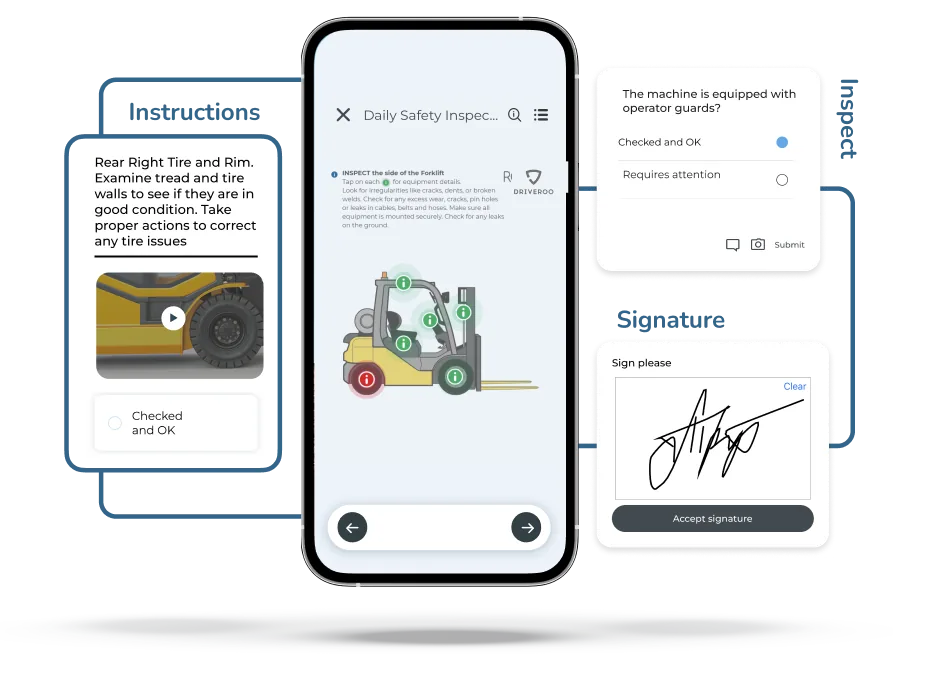
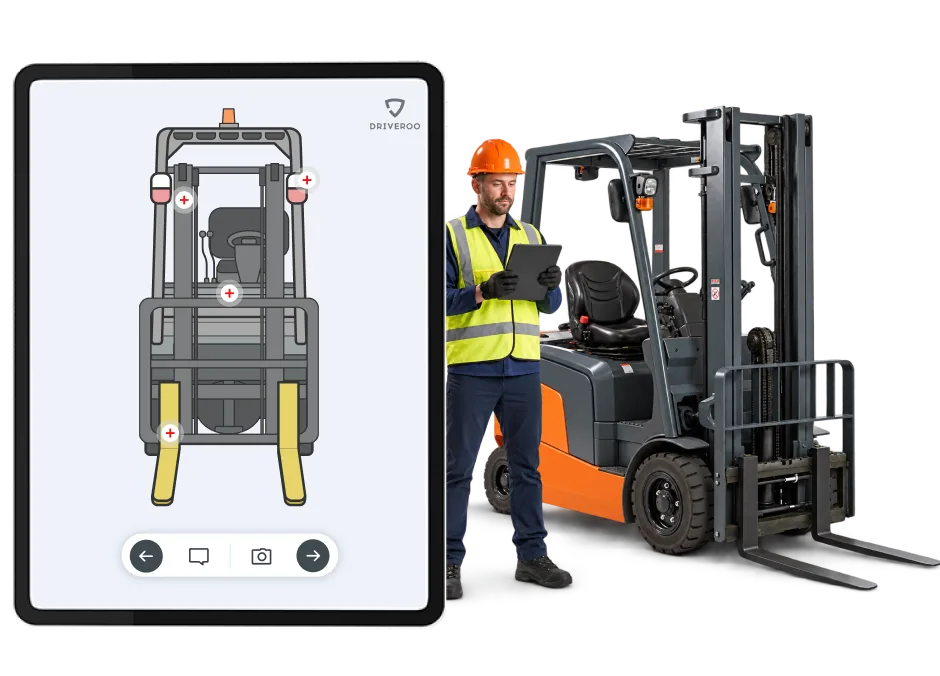
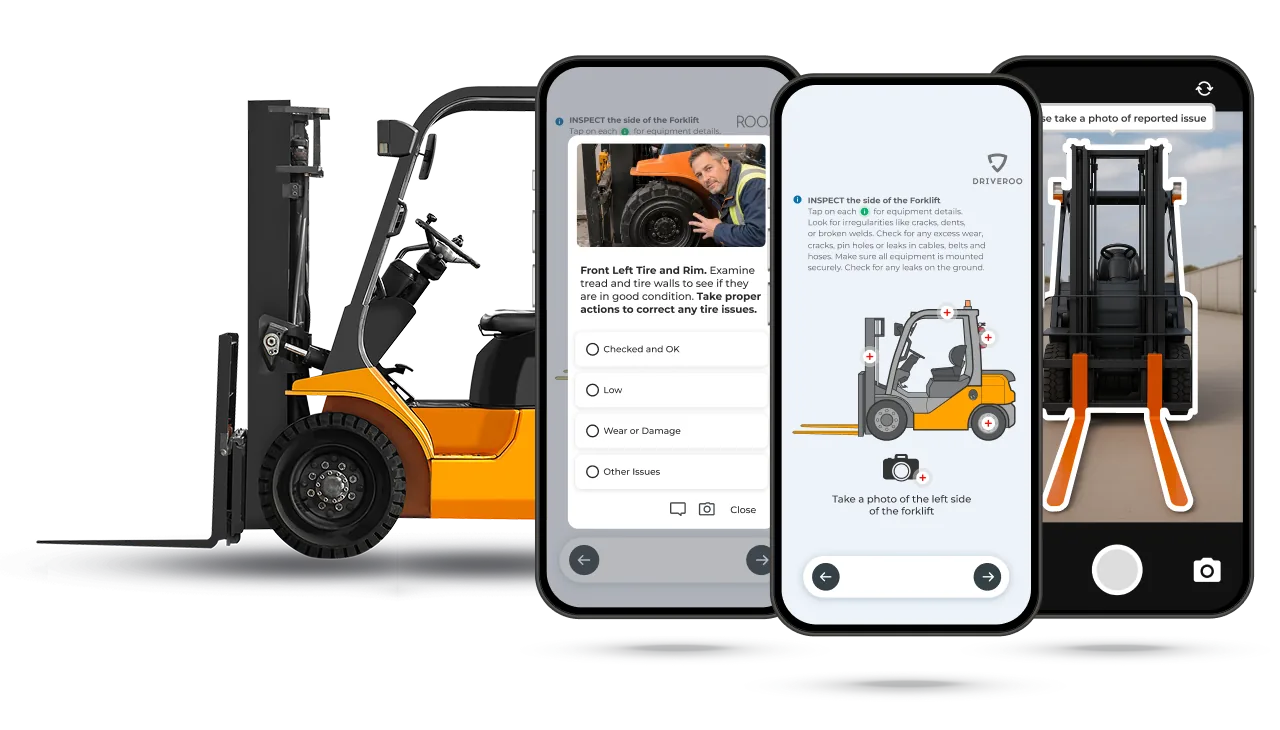
Overview: Driveroo, powered by ROO.AI, operates as a single platform that manages compliance, safety and maintenance together, often used to manage fleets of all types of equipment. The pre-op forklift check is an entry point into a variety of automated safety, maintenance, and compliance processes. A flagged defect can auto-generate a maintenance work order and feed a preventive maintenance schedule set by operating hours, carrying the finding through to resolution rather than leaving it in a completed form. On frontline guidance, Driveroo shows operators the actual forklift visually and guides them to the exact inspection point, with conditional logic and prior-issue recall built to prevent pencil-whipping. Its AI-directed guidance and embedded micro-training help a newer operator work more like an experienced one without leaving the inspection flow.
Best for: Warehouses, manufacturing floors, and distribution operations that want one platform to run forklift inspections at any scope, close the loop from defect to repair natively, and guide frontline operators toward more consistent, expert-level checks.
Key features
Visual, asset-specific guided inspection interface for forklifts and power lift equipment. Conditional-logic guidance that adapts the inspection in real time. Single-tap, multi-select, and All Clear controls with voice-to-text notes. Options for mandatory photo and video evidence on flagged items. Recall of prior issues to prevent skipped or rubber-stamped steps. Automatic work-order generation from flagged issues. Preventive maintenance scheduling based on operating hours. Embedded micro-training and how-to instructions delivered inside the inspection flow. Real-time dashboards, missed-inspection alerts, and audit-ready compliance reports. Telematics integrations including Samsara, Azuga, Motive, and Verizon Connect. Works online and offline on iOS and Android.
Limitation
Driveroo's parts and warranty management is lighter than a dedicated CMMS. A highlight of the platform is the visual inspection interface, but there is no current self-authoring tool for inspection workflow creation. Driveroo offers a concierge service as part of its subscription to implement all workflows making it more applicable to broader departmental or organizational projects rather than smaller, DIY paper checklist replacements. The company reports that an AI-based self-authoring function is on the roadmap.
See how guided forklift checks work end to end: Driveroo Forklift Inspection Software
Frequently Asked Questions
Forklift inspection software is a category of mobile apps that guide operators through the pre-shift and post-shift checks required to safely operate a powered industrial truck, replacing a paper checklist with a structured, traceable digital workflow for warehouse forklift inspection and other material handling operations. It is also called forklift inspection apps, powered industrial truck inspection software, or digital forklift checklists. Some examples include: SafetyCulture, MaintainX, MasterCheck, J.J. Keller, Fleetio, and Driveroo.
The leading forklift inspection options for 2026 include SafetyCulture (DIY, low-cost checklists built from community templates), MaintainX (maintenance-linked inspections with meter-based PM), MasterCheck (a purpose-built, low-cost forklift circle-check app), J.J. Keller (forklift checks inside a broader DOT compliance platform), Fleetio (forklift checks inside a general equipment maintenance platform), and Driveroo (a visual, guided platform that closes the loop from inspection to defect repair and preventive maintenance). The best fit depends on whether you want a standalone forklift tool or one platform tied to a broader maintenance or compliance stack.
They differ more than a shared checklist format suggests. Most trace back to one of three origins: digital forms replacing paper, CMMS and fleet management, or regulatory compliance and training platforms, and that origin determines what is native versus what has to be built with custom forms. Scope of the solution is one differentiator with basic products simply capturing inspection results and more advanced products automating end-to-end processes for maintenance and repair along with safety compliance checks. Usability and embedded guidance is another difference which starts with simple text forms and extends to visually guided inspections with logic and smart automation. Finally the use of AI is a new differentiator starting with AI used for forms template authoring to AI search CoPilots and reaching ultimately to AI guidance in the workflows.
Start with scope: does the tool only run the pre-op check, or does it extend into broader safety and maintenance workflows your operation will eventually need. Then evaluate native closed-loop capability, meaning whether a failed check can generate a work order, schedule preventive maintenance by operating hours, and carry through parts and warranty tracking without a second system. Finally, weigh frontline guidance and AI: a platform that guides and upskills the operator during the inspection itself, rather than only analyzing data after the fact, tends to produce faster onboarding and more consistent results across a mixed-skill workforce.
Under 29 CFR 1910.178(q)(7), a powered industrial truck must be examined before it is placed in service, and trucks used on a round-the-clock basis must be examined after each shift. OSHA does not require the daily inspection to be documented, but a digital record gives an employer proof that inspections are being performed and gives operators a fast way to flag defects and take a unit out of service before it causes an incident.
Generally not on its own. A CMMS manages work orders, parts, vendors, and cost tracking across an entire maintenance program. A forklift inspection app operationalizes the daily and PM checks themselves and, in stronger platforms, feeds findings into work orders and PM schedules. Platforms such as Driveroo, MaintainX, and Fleetio that include native work-order automation and operating-hour PM scheduling may fill that role for a forklift fleet, but buyers with broader maintenance needs should evaluate CMMS depth separately from forklift-specific inspection capability.
Most platforms in this comparison document offline capture, meaning an operator can complete an inspection without a live connection and have it sync once back online. Driveroo, SafetyCulture, MaintainX, and Fleetio explicitly document offline inspection capture; offline support for MasterCheck and J.J. Keller's forklift-specific workflow was not explicitly confirmed in vendor documentation at research time.
See it on your own equipment
Turn every forklift check into a closed loop, from defect to repair
Get Live Demo© Driveroo 2026 | Privacy | Asset and Fleet Management Software
This site uses cookies. We do this to remember your preferences so that we can improve our service. By using our site, you agree to our use of cookies.